
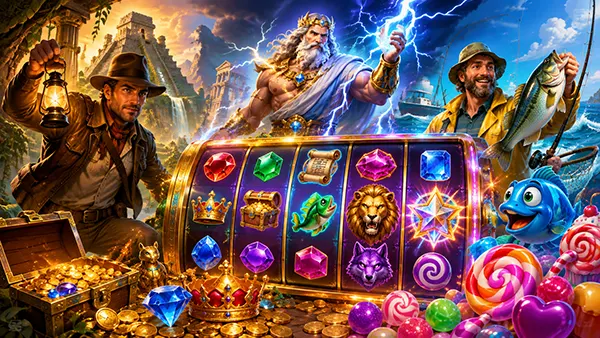
Themed Slots: How Stories, Characters and Design Influence Popularity
A themed slot is more than a set of reels placed over an attractive background. Its subject, characters, symbols, animation and sound create the first impression, while the underlying rules determine whether the game remains clear and engaging after that initial interest. By 2026, online slot catalogues contain thousands of titles built around mythology, fishing, ancient civilisations, sweets, animals, horror, television series and many other subjects. The most recognisable games usually combine a simple visual identity with features that suit the setting. A strong theme can help a title stand out in a crowded game lobby, make its rules easier to remember and support a series of related releases. It cannot change the mathematical result of a spin, however, and attractive artwork should never be confused with better odds. Understanding the role of theme helps explain why some slots remain familiar for years while many visually polished releases receive only brief attention.
Why a Clear Theme Makes a Slot Easier to Remember
Players often see a slot thumbnail, title and short preview before they read any information about paylines, volatility or bonus rounds. The theme therefore works as a quick classification system. An Egyptian temple suggests treasure, hidden chambers and ancient symbols; a fishing game suggests boats, tackle and collected catches; a sweet-shop setting suggests bright colours, fruit and confectionery. These associations reduce the amount of explanation required at the selection stage. A title such as Gates of Olympus immediately signals Greek mythology, while Big Bass Bonanza communicates its fishing subject before the reels open. This clarity matters because online casino menus commonly display many games at once, particularly on a mobile screen. A theme that can be understood in a second has a practical advantage over artwork that is detailed but difficult to interpret. Recognition does not guarantee sustained interest, but it gives the game a better chance of being noticed and correctly remembered.
A coherent theme also gives separate visual elements a shared purpose. Backgrounds, reel symbols, character poses, button shapes and sound cues feel more convincing when they appear to belong to the same setting. In Book of Dead, the Egyptian imagery, adventurer protagonist and expanding-symbol feature form a consistent adventure concept. In Sweet Bonanza, colourful sweets, fruit symbols and tumbling wins support a light, arcade-like presentation. The story in either case is not comparable to a film or novel; it is a compact frame that explains what the player is seeing. This is important because slot sessions consist of repeated actions. A clear frame makes those repeated actions feel connected rather than random pieces of decoration. When visual choices conflict with one another, the game may look expensive but still lack identity. Strong themed design is usually selective: it chooses a limited set of recognisable ideas and repeats them consistently.
Storytelling in slots is normally delivered through short moments rather than long scenes. A character may react to a feature trigger, a door may open before free spins, or the background may change when a multiplier grows. These brief sequences give the session a sense of progression without delaying the next decision. Gonzo’s Quest is a well-known example: Gonzo appears beside the reels, celebrates larger results and remains linked to the search for El Dorado, while the Avalanche feature makes symbols fall into place rather than using a conventional reel reset. The character, setting and movement support one another. This type of integration is more effective than adding a generic mascot to mechanics that have no connection with the subject. The theme becomes memorable because the player repeatedly sees the same relationship between action and presentation. The story is simple, but it has a visible role in the way the game communicates.
Familiar Subjects and Recurring Characters
Certain subjects return frequently because they can be understood across several markets. Ancient Egypt, Greek and Norse mythology, animals, fantasy creatures, fruit, gems and seasonal celebrations all provide recognisable symbols without requiring detailed background knowledge. They also give designers a broad visual vocabulary. Zeus can be associated with lightning and multipliers, an Egyptian book can act as a scatter or expanding symbol, and a fisherman can collect cash-value fish during a bonus round. These links help a feature feel natural inside the chosen setting. The risk is repetition. A new title built around the same pyramid, pharaoh and golden scarab imagery may be difficult to distinguish from dozens of similar games. A familiar subject therefore works best when the studio adds a specific character, visual style or mechanical idea. The subject opens the door; the individual treatment determines whether the game develops its own identity.
Recurring characters give studios a way to build recognition across several titles. Rich Wilde first appeared in Play’n GO’s Book of Dead in 2016 and has since been used in further adventures with different settings and game formats. The character acts as a visual link even when the reel structure changes. In 2025, Rich Wilde and the Tome of Dead moved the concept to a 5-by-5 cascading grid, while Book of Dead GO Collect returned in 2026 with a 5-by-3 format and a new treasure-vault feature. This approach combines familiarity with variation. A returning character can reduce the learning barrier because the title and artwork already feel known, but the sequel still needs a clear reason to exist. Changing only the maximum win or adding a number to the name may produce short-term attention. A stronger sequel preserves the identity of the series while giving the player a noticeably different feature, layout or visual situation.
Series design is also visible in Pragmatic Play’s Big Bass titles and Gates games. The fisherman, fish symbols and collection feature have appeared in several Big Bass variations, including Megaways, three-reel, seasonal and 1000-branded editions. Gates of Olympus established Zeus beside a 6-by-5 grid with tumbling wins and multiplier symbols, and later releases retained the recognisable god-and-gates identity while adjusting the feature set. These examples show why a character does not need a complex biography to become useful. Repetition of posture, voice, symbols and role can be enough. At the same time, frequent sequels can weaken a series when names and thumbnails become too similar. The strongest families keep a stable visual anchor but make each edition easy to distinguish. Clear naming, a different background, a revised grid or a new bonus structure helps players understand which version they are selecting.
How Characters, Artwork and Sound Affect Player Choice
Characters provide a human or expressive focal point in a format dominated by symbols and interface controls. A face can communicate humour, danger, confidence or curiosity more quickly than a paragraph of description. Gonzo’s exaggerated reactions, Rich Wilde’s adventurer image and the fisherman in Big Bass Bonanza each give the game a recognisable centre. Animal characters can serve the same purpose, especially when they are given clear roles rather than being used as decorative icons. Pragmatic Play’s Dog House series, for example, uses a group of stylised dogs as the main identity and later places them in different situations. This creates a tone that is easy to recognise from a small thumbnail. Character appeal is subjective, however. A design that seems amusing to one audience may appear childish or overused to another. Effective character work therefore depends on consistency and suitability, not simply on adding a mascot.
Visual clarity is particularly important on phones, where reel symbols, values and controls must remain readable on a limited screen. Detailed artwork may look impressive in a promotional image but become confusing when reduced to the size of a symbol. Successful mobile design uses strong silhouettes, controlled colour contrast and clear separation between high-value symbols, low-value symbols, scatters and wilds. Starburst remains a useful example of visual economy: gems, bars and sevens are presented against a dark space background, while the expanding wild is immediately visible. The theme is simple, but the result is easy to read. More elaborate games can achieve the same clarity by limiting animation during ordinary spins and reserving larger effects for meaningful events. When every symbol flashes, shakes or produces particles, the important information becomes harder to follow. Good artwork guides attention rather than competing for it.
Sound contributes to identity even when players do not consciously analyse it. A short melody can establish a cultural or emotional setting, while a distinct feature sound tells the player that the game state has changed. Music may become more intense as a bonus approaches, then shift during free spins. Character voices can reinforce humour or drama, but repeated phrases quickly become irritating when there are too few variations. The best sound design remains informative at a low volume and does not depend on constant celebration. It should also distinguish a real win from a visually active but non-winning event. This matters because responsible design requires clear communication. Music and animation can make a game feel faster or more significant, yet they do not alter the random outcome. Players should be able to mute sound, understand the result from the screen and see their balance and stake without decorative elements obscuring them.
When the Theme Supports the Game Mechanics
The strongest themed slots connect a feature to an action that makes sense within the setting. In Big Bass Bonanza, fisherman wilds collect the values shown on fish money symbols during free spins. The rule is easy to explain because the character performs the same action suggested by the fishing theme. In Gates of Olympus, Zeus stands beside the reels and multiplier symbols appear as part of a mythological display built around his power. In Gonzo’s Quest, falling symbols and repeated cascades support the feeling of moving through an expedition. These links do not make one mathematical model better than another, but they make the rules easier to recall. A player who returns after several weeks may remember that the fisherman collects fish values even if the exact paytable has been forgotten. Theme therefore acts as a memory aid when it describes what a feature actually does.
Problems arise when presentation suggests an outcome that the rules do not support. A character may appear to “nearly” unlock a feature, an animation may make a small return look like a major success, or a narrative may imply that progress is being stored when every spin is independent. Regulated games must present rules and results clearly, and random outcomes should not adapt to a person’s previous wins or losses. A theme should explain the entertainment concept, not create a false impression of control. Developers can avoid confusion by showing trigger requirements, multiplier values and remaining free spins in plain view. Characters can react to events, but their reactions should match the actual result. This distinction is important because visual storytelling is persuasive. When the theme is used responsibly, it helps a player understand the game. When it is used carelessly, it can make ordinary random events appear more meaningful than they are.
Mechanical fit also affects pacing. A horror slot may use slower transitions, darker sound and suspense before a feature, while a sweets or fruit game may use quick tumbles and bright bursts. Neither approach is automatically better. The pace should suit the subject without making basic information difficult to read. A long cinematic sequence becomes frustrating if it appears after every modest combination, while an abrupt bonus can feel disconnected from an adventure theme that promises progression. Modern games often allow introductory sequences to be skipped and keep the main controls in a fixed position. This is a practical compromise between atmosphere and usability. The theme can add anticipation, but the player should remain in control of sound, stake selection and the speed allowed by local rules. Design works best when the visual layer supports the rhythm of the feature instead of delaying or disguising it.
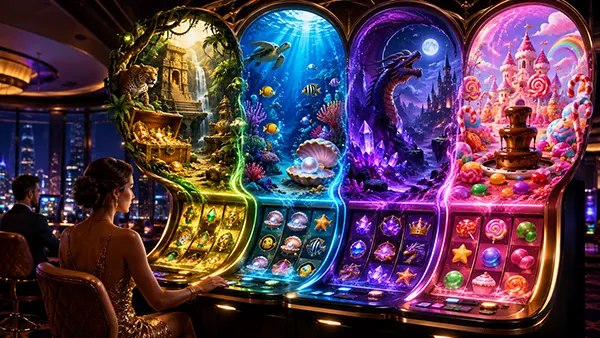
What Helps a Themed Slot Remain Popular Over Time
Long-term recognition usually depends on a combination of simplicity and distinctiveness. Starburst uses a space-and-gems theme that can be understood immediately, Gonzo’s Quest has a recognisable protagonist and unusual cascading presentation, and Book of Dead links an adventurer character with a familiar Egyptian adventure. None of these concepts requires a lengthy explanation. Their visual identity can be represented by one character, one symbol or one colour arrangement, which helps them remain visible in large catalogues. Continued availability also matters. A game cannot build recognition if it appears briefly or is restricted to a small number of sites. Studios and operators tend to keep titles that perform reliably, while familiar names are often placed in recommended or classic sections. This creates a reinforcing effect: visibility supports recognition, and recognition supports further visibility. It is therefore difficult to separate design quality from distribution and long-term commercial support.
Sequels can extend the life of a theme by serving two different needs. Existing players receive a familiar setting, while the studio can introduce a newer mechanic or presentation style. The Book of Dead family illustrates this process across a decade, and Play’n GO reported strong regulated-market performance for Book of Dead GO Collect after its February 2026 release. Pragmatic Play has used a similar approach with Big Bass Bonanza, adapting the fishing identity to Megaways, compact reel layouts, seasonal editions and other feature structures. A successful series is not proof that every instalment is equally strong. It does show that visual memory has commercial value. The main challenge is avoiding fatigue. New editions need meaningful differences and transparent naming, otherwise the series becomes difficult to navigate and the original identity loses focus.
Local relevance can also influence how a theme is received. Folklore, sport, food, festivals and historical figures may attract attention in one country but mean little in another. Studios therefore adapt language, symbols and cultural references, or select broad themes that travel easily. Care is required with sacred imagery, stereotypes and real historical events. A design may be legally available yet still feel careless or inaccurate to the audience it depicts. Licensed television and film slots face a different challenge: recognisable actors, logos and music can create immediate interest, but the game must still function when the novelty fades. NetEnt’s Narcos and Vikings slots, for example, use familiar characters and scenes from their respective series while linking them to specific features. Brand recognition helps the first selection; clear rules and usable design determine whether the title remains playable after that first impression.
How to Assess a Theme Beyond Its Appearance
A player evaluating a themed slot should separate presentation from the game’s published information. The artwork may suggest treasure, power or repeated progress, but the practical details are the return-to-player figure, volatility description, stake range, paytable, feature rules and maximum win. These factors vary between titles and, in some cases, between approved versions of the same title. The help screen should explain how wins are formed, what triggers free spins, how wilds and scatters behave and whether any feature changes the stake. A clear game makes this information accessible before real-money play. The theme can make the rules easier to remember, but it should not replace them. A familiar character or attractive series name is not evidence of higher returns, more frequent wins or a safer spending pattern.
Demo play can be useful for checking readability, sound, animation and the logic of a feature, provided the free version follows the same approved rules as the real-money game. It cannot predict what will happen in a future session. Random-number-generated outcomes are designed to be independent, so a long run without a bonus does not make the next spin “due”. The same principle applies to visual patterns: two scatter symbols, a character reaction or a nearly completed meter may be part of the presentation rather than evidence that a feature is about to occur. Players should judge whether the game communicates this distinction honestly. Controls for stake, sound and game information should be easy to reach, and the balance should remain visible. If the theme makes it difficult to understand what was spent or won, the design has failed at a basic practical level.
Themed slots are popular because they turn an abstract reel game into something easier to recognise, describe and remember. Stories provide context, characters create identity, and visual and audio design guide attention. Their influence is strongest when each element supports the rules rather than covering them. The 2026 market shows that studios continue to build families around established characters such as Rich Wilde, Zeus and the Big Bass fisherman, while new titles compete through distinctive art and clearer mobile presentation. Popularity, however, should not be treated as a measure of value for an individual player. The sensible approach is to check the rules, use spending and time limits, and regard the theme as entertainment rather than a signal about future results. A memorable design can improve understanding and enjoyment, but the outcome remains random and the cost remains real.